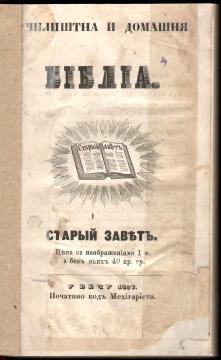
Učilištna i domašnaja Biblija: Stari zavjet
The first printed edition of the translation of parts of the Old Testament from Church Slavonic (and German) into the Serbian vernacular. The work by Bishop Platon Atanacković was intended for school and home use, with 21 copperplate engravings by Viennes
An important monument of Serbian biblical literature of the 19th century, it is a significant work by the Serbian Orthodox bishop, writer and cultural worker Platon Atanacković (1788–1867), born in Sombor. It was published in 1857 in Vienna by the prestigious Mechitarist Printing House (Mechitaristen Druckerei), known for its high-quality church and scientific publications.
This is the first printed edition of the translation of parts of the Old Testament into modern Serbian (the vernacular language of the time). Atanacković translated from Church Slavonic and partly from German, striving to make the biblical text accessible to a wider audience, especially students and families. The book is intended for school (university) and home (domestic) use, which emphasizes its pedagogical and religious-educational character.
The work covers most of the Old Testament, with an emphasis on the books that were most needed for religious instruction and education. The format is compact, making it practical for everyday use. Of particular value are 21 copperplate engravings (etchings) made by Viennese masters – each is signed, and the illustrations depict key biblical scenes and motifs. The illustrations were an important element for better understanding the text, especially among younger readers.
Platon Atanacković, Bishop of Buda (1839–1851) and Bačka (1851–1867), President of Matica Srpska and a great promoter of Serbian culture and education, dedicated a large part of his life to translation and educational work. His translations of the Bible represent an important step in the development of the Serbian biblical language before the final Daničić-Karadžić translation. He worked to bring the sacred text closer to the people, fighting against the predominant use of Church Slavonic, which was becoming less and less understandable.
The special importance of the edition lies in the linguistic aspect: Atanacković consistently opposed Vuk's reform of the Serbian language and advocated a more traditional, literary-ecclesiastical idiom. This translation is therefore not only a pedagogical reading, but also a direct testimony of the language struggle of the time – in terms of vocabulary, spelling solutions and style that retain pre-Vuk norms. In this sense, the book is a valuable source for studying the relationship between church tradition, school canon and language standardization in the 19th century.
The 1857 edition is considered a rarity among antiquarian books. Today it is valued as a key monument of Serbian Orthodox culture, the history of translation and the development of the literary language in the 19th century. It reflects the efforts of the Serbian intelligentsia in the Habsburg Monarchy to raise public education and strengthen religious identity through understandable language and quality publications.
The style of the translation is solemn, but more accessible than pure Church Slavonic, with the aim of making the text clear and instructive. The book remains an important source for the study of Serbian bibliography, theology, and cultural history. Antiquarian copies are highly sought after for their historical significance and beautiful illustrations.
One copy is available
- Restored