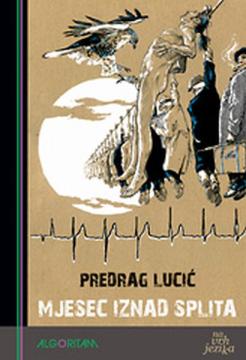
Mjesec iznad Splita

Mjesec iznad Splita

Predrag Lucić

Predrag Lucić's second book of poetry, after "The Lovers from Verona" (2007), is a collection of irony, melancholy and contempt for canons - a dedication to the "ridicules" of Split, those who have woven their antics into the city's collective memory.

Through a dozen poems, Lucić brings to life characters like Karuz, a carpenter from Nazareth who becomes a Split marangun, or J.P. Kamov, a genius condemned to pauperism, where the moon looms over Split like an observer of other people's dreams and defeats. The poems are not just satire; they are hymns of courage and self-identity – the characters are not madmen, but mirrors of ourselves, full of Split's vitality, humor and sadness. "Karuzo" evokes biblical irony, "Mjesec iznad Splita" – an epic about a city where the sacred mixes with the profane, and love with escape.

Lucić's language is raw, rhythmic, full of Split dialect and surreal images: the moon as a witness, the sea as oblivion, the characters as "trainers" of existence. The collection is a critique of social hypocrisy, but also a love letter to his native Split – a place where unrest turns into art. After Lucić's death, the collection was published as part of "The Southern Courtyard" (2024), a legacy that makes him a significant author of the Croatian language.

Editor
Kruno Lokotar
Illustrations
Alem Ćurin
Dimensions
19 x 13 cm
Pages
175
Publisher
Algoritam, Zagreb, 2012.
 
Latin alphabet. Paperback.
Language: Croatian.

One copy is available

Condition:Used, excellent condition
Discounted price: 6.344.76
25% discount is valid until 4/6/26 11:59 pm
 

Are you interested in another book? You can search the offer using our search engine or browse books by category.

You may also be interested in these titles

Veseli šalabahter

Veseli šalabahter

"Veseli šalabachter" is a witty, playful and very accessible collection that shows through humor how one can write about ordinary topics in a completely unexpected way.

Karitativni fond UPT, 2004.
Croatian. Latin alphabet. Paperback.
2.98
Ljepuškasta djeca

Ljepuškasta djeca

Jiří Šotola

The novel Beautiful Children depicts the world of adolescent rebels in a "re-education" colony - a prison disguised as a school. Written in the spirit of the Prague Spring, the work criticizes the communist system through a dynamic, cinematic narrative.

August Cesarec, 1986.
Croatian. Latin alphabet. Hardcover with dust jacket.
4.82 - 4.84
Mali mitovi

Mali mitovi

Stanisław Jerzy Lec
Književna zajednica Novog Sada, 1986.
Croatian. Latin alphabet. Paperback.
5.22
Znanstveni heureka Maskolta Miška

Znanstveni heureka Maskolta Miška

Ksaver Šandor Gjalski
Humoristična knjižnica, 1911.
Croatian. Latin alphabet. Paperback.
7.36
Stric Josif

Stric Josif

Veikko Huovinen

The book Uncle Joseph (1988) is a satirical collection of 15 stories about the life of Joseph Stalin, written by the Finnish writer and forestry expert (1927–2009) as "memories of a contemporary." The moral of the work is that power corrupts, and satire h

Znanje, 1992.
Croatian. Latin alphabet. Hardcover with dust jacket.
6.54 - 7.12
Clochemerle Babilon: Svezak drugi

Clochemerle Babilon: Svezak drugi

Gabriel Chevallier
Zora, 1967.
Croatian. Latin alphabet. Hardcover with dust jacket.
3.72