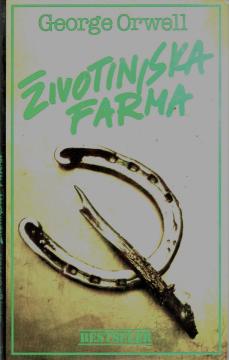
Životinjska farma
"Animal Farm" is a short satirical dystopian novel by British writer George Orwell (Eric Arthur Blair), one of the most influential works of the 20th century. Orwell uses a simple, fairy-tale style to criticize totalitarianism and government corruption.
In George Orwell's allegorical novel Animal Farm (1945), the animals at Manor Farm revolt against man and drive out Farmer Jones. They establish an equal society under the motto "All animals are equal". Pig Napoleon takes over, changes the rules and turns the farm into a dictatorship, where "All animals are equal, but some are more equal".
The plot is an allegory of the October Revolution and the rise of Stalinism in the USSR. The animals on the English farm Manor Farm, led by the old sow Major (symbol of Marx/Lenin), rebel against the cruel farmer Jones (Czarism). After the revolution, the farm becomes the Animal Farm, and the seven commandments of Animalism ("All animals are equal", "Whatever walks on two legs is the enemy", etc.) become the basis of the new society.
Two fillies – Snowball (Trotsky) and Napoleon (Stalin) – are fighting for leadership. Napoleon, with the help of dogs (secret police), expels Snowball and takes absolute power. He gradually changes the orders (e.g. "Animals are not allowed to sleep in bed" → "no sheets"), lives luxuriously, trades with people and completely betrays the ideals of the revolution. In the final scene, the animals no longer distinguish pigs from humans - the dictatorship is complete.
The book was rejected by several publishers due to its criticism of the USSR during World War II, but it became a classic of anti-Stalinist literature. It was popular in post-war Yugoslavia, often interpreted as a criticism of Stalinism and bureaucratic socialism. Today it is read as a universal parable about power, propaganda and the betrayal of idealism. One of the most important works of political satire, along with 1984.
No copies available
The last copy is reserved.