Crnac

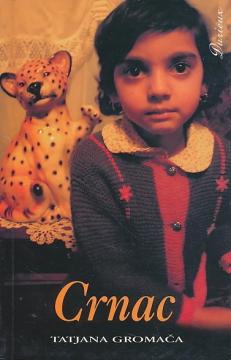
Crnac

Tatjana Gromača

The novel The Black Man begins with the sentence “The house we lived in was wooden.” Wooden houses are reserved for fairy tales and stories for children.

The author does indeed write about childhood, a childhood that could be hers, but the narrator has no name, nor does the village she lives in, nor the city she goes to study in. The novel is composed of short fragments that sometimes read as short stories, sometimes as flashes of memory, and sometimes as prose poems. There are no elements of a fairy tale in the narrator's childhood, quite the opposite. In the suburbs of a provincial town known for its heavy industry, the child grows up surrounded by poverty, provincialism, and the subtle terror of people living empty lives. Going to study in a big city doesn't change anything either. The streets are bigger, a little better lit, but people with "empty gazes" still follow her. Gromača writes about the same Eastern European poverty described by Slavenka Drakulić, the same attitude towards women that Dubravka Ugrešić wrote about, but her prose fragments are closer to Danilo Kiš's novel The Garden, Ashes, Milan Kundera's The Joke, Agota Kristof's The Great Notebook, and Szymborska's poetry. Tatjana, like all good poets, knows how to say a lot with few words.

Editor
Nenad Popović
Dimensions
20 x 13 cm
Pages
159
Publisher
Durieux, Zagreb, 2004.
 
Latin alphabet. Paperback.
Language: Croatian.

One copy is available

Condition:Used, excellent condition
 

Are you interested in another book? You can search the offer using our search engine or browse books by category.

You may also be interested in these titles

Začuđeni svatovi

Začuđeni svatovi

Eugen Kumičić

The novel "The Surprised Wedding Party" tells the story of the unrequited love of Antonio, a poor young man, for the beautiful daughter of a fisherman, Marija. Along with the aforementioned love story, another plot stands out, and that is the secret love

Školska knjiga, 1982.
Croatian. Latin alphabet. Paperback.
The book consists of two volumes
2.00 - 5.64
Proces

Proces

Franz Kafka

Kafka wrote The Process between 1914 and 1915, published posthumously in 1925. The novel is unfinished but with an added final chapter by Max Brod. Edition with a foreword by B. Živojinović and an afterword by Walter Killi.

BIGZ, 1990.
Serbian. Latin alphabet. Paperback.
4.26
Zagrepčanka

Zagrepčanka

Branislav Glumac

Branislav Glumac published a novel without periods or commas in 1974, as the relentless stream of thought of a young rebel. Published in socialist Yugoslavia, the work caused a scandal with its openness and became a classic about generational rebellion.

IROS, 1986.
Croatian. Latin alphabet. Hardcover.
8.24
Pariški maraton : Knjiga pisanja (Pariz21. i 22. oktobar 2023)

Pariški maraton : Knjiga pisanja (Pariz21. i 22. oktobar 2023)

At the end of the eighties, Damir Uzunović traveled to Paris and stayed there for less than a year. He was twenty years old at the time, and that exile episode would be formative for the literature he would later write.

Buybook, 2024.
Croatian. Latin alphabet. Hardcover.
12.22
Knjižarevo obećanje: Cliff Janeway istražuje

Knjižarevo obećanje: Cliff Janeway istražuje

John Dunning

The Bookseller's Promise is the third book in the Cliff Janeway series by the award-winning John Dunning, an unusually talented and unique American writer.

Algoritam, 2006.
Croatian. Latin alphabet. Paperback.
4.50 - 4.68
Godan

Godan

Munshi Prem Chand
Kosmos, 1960.
Serbian. Latin alphabet. Paperback.
4.22 - 4.26