Satir iliti divlji čovik

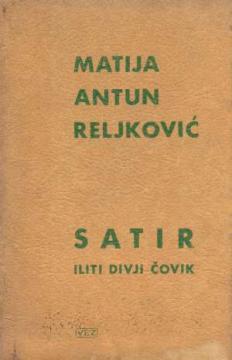
Satir iliti divlji čovik

Matija Antun Reljković

The Enlightenment poem Satyr or the Wild Man by M. A. Reljković, through the dialogue between Satyr and Slavonian, sharply criticizes outdated customs and negligence and calls for education, work, and progress in Slavonia.

Satyr or the Wild Man (1st edition 1762, expanded in 1779) is the most important work of the Croatian Enlightenment, authored by the Slavonian writer and officer Matija Antun Reljković. Composed in the folk ten-line meter, this didactic-satirical poem was written with the clear intention of educating, instructing and economically uplifting the Slavonian peasantry after a century of Ottoman rule. The central part of the framework is the figure of Satyr – a mythical forest creature (“wild man”) – who observes Slavonia and, in a direct dialogue with a Slavonian peasant, offers a sharp criticism of the way of life of that time. Satyr does not spare the folk vices: superstition, drunkenness, idleness, neglect of agriculture, swearing and ignorance, labeling them the main culprits for the poverty and backwardness of the region. In contrast, Reljković glorifies the natural resources of Slavonia and offers specific Enlightenment advice on hygiene, rational economy, education and moral life. Although imbued with a Christian and moralistic spirit, the work had an extraordinary social and cultural impact. Satyr or Wild Man became extremely popular among contemporaries and remains a key testimony to the struggle for enlightenment and modernization of the Croatian countryside in the 18th century.

Editor
Ivo Bogner, Pavle Blažek
Graphics design
Predrag Gol
Dimensions
21 x 14 cm
Pages
159
Publisher
Glas Slavonije, Osijek, 1974.
 
Latin alphabet. Hardcover.
Language: Croatian.

Multiple copies are available

Copy number 1

Condition:Used, very good condition
Damages or inconvenience notice:
  • Slight damage to the cover

Copy number 2

Condition:Used, excellent condition

Copy number 3

Condition:Used, very good condition
Damages or inconvenience notice:
  • Pohabane korice
 

Are you interested in another book? You can search the offer using our search engine or browse books by category.

You may also be interested in these titles

NEXUS haiku

NEXUS haiku

Michael Dudley, Tomislav Maretić, Dejan Pavlinović
Centar znanja, 2021.
Croatian. Latin alphabet. Paperback.
2.50
Pogled u Bosnu ili kratak put u onu Krajinu: učinjen 1839-40. po Jednom Domorodcu

Pogled u Bosnu ili kratak put u onu Krajinu: učinjen 1839-40. po Jednom Domorodcu

Matija Mažuranić
Konzor, 1992.
Croatian. Latin alphabet. Hardcover.
7.24
Tri novele: Put u novi život / Pečat / Hobotnica

Tri novele: Put u novi život / Pečat / Hobotnica

August Cesarec
Školska knjiga, 1966.
Croatian. Latin alphabet. Paperback.
2.50
Sretan kraj

Sretan kraj

Pavao Pavličić

In terms of genre, the novel is a combination of fantasy and crime. As in some earlier novels, the novelist touched on certain themes that "hang" in the air. It would be said that the writer anticipates real events.

Znanje, 1989.
Croatian. Latin alphabet. Hardcover with dust jacket.
5.42
Tirena

Tirena

Marin Držić

Pastoral drama (comedy) in five acts, written in double-rhymed twelve-line stanzas (with eight-line stanzas in the lyrical parts), the oldest preserved play by Držić (premiered in 1548 in Dubrovnik, printed in 1551 in Venice).

Matica hrvatska, 1948.
Croatian. Latin alphabet. Hardcover.
7.36
Tri novele: Put u novi život / Pečat / Hobotnica

Tri novele: Put u novi život / Pečat / Hobotnica

August Cesarec
Školska knjiga, 1969.
Croatian. Latin alphabet. Paperback.
1.25 - 1.26