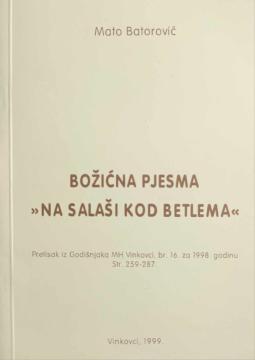
Božićna pjesma "Na salaši kod Betlema"

Božićna pjesma "Na salaši kod Betlema"

Mato Batorović

A traditional Croatian folk song from Slavonia, part of the rich heritage of folk Christmas carols. The song, known for its simple but heartfelt melody and lyrics, celebrates the birth of Jesus Christ. Reprinted from the MH Vinkovci yearbook, no. 16, 1998

The text is written in the Chakavian dialect, marked by picturesque expressions and folk spirit, and is often performed to the accompaniment of traditional instruments such as the flute and bagpipes.

The song begins with a depiction of a farm near Bethlehem, where shepherds tend sheep and invite others to come to the stable where the Savior was born. The lyrics emphasize togetherness, joy, and the sharing of simple gifts such as cheese, cream, sherbet, and pork shoulder, which symbolize modesty and hospitality. The song mentions Mary and Joseph watching over the baby Jesus, celebrating the joy of Christmas with singing and music. The motif of togetherness and celebration runs through the lyrics, where the entire village joins in the celebration, and the music reaches everyone.

The significance of the song lies in its role in preserving Croatian folklore tradition, especially Slavonian, where Christmas carols are sung during Advent and Christmas in churches, homes, and at folk gatherings. According to sources, such as the Croatian Song blog, the song is part of the intangible cultural heritage, revived by the work of ethno-artists such as Dunja Knebl and the Lado ensemble. Its simplicity and warmth make it a favorite among singers and listeners, and the lyrics reflect the spirit of folk piety and the joy of Christmas.

Maße
20 x 14 cm
Verlag
MH Vinkovci, Vinkovci, 1999.
 
Latein Schrift. Taschenbuch.
Sprache: Kroatisch.

Angeboten wird ein Exemplar

Zustand:Gebraucht, in ausgezeichnetem Zustand
Zum Warenkorb hinzugefügt!
 

Interessieren Sie sich für ein anderes Buch? Sie können das Angebot über unsere Suchmaschine suchen und finden oder Bücher nach Kategorien durchsuchen.

Diese Titel könnten Sie auch interessieren

Proljeće: glazba za mladež god. III, sv. 1

Proljeće: glazba za mladež god. III, sv. 1

Proljeće: glazba za mladež was a musical and pedagogical magazine for children and youth that acted as the official publication of the Ustaša Mladeža during the NDH, publishing sheet music, songs and educational content.

Vlastita naklada, 1942.
Kroatisch. Latein Schrift. Taschenbuch.
13,42
Mirno teku rijeke: Stihovi 1957.-2005.

Mirno teku rijeke: Stihovi 1957.-2005.

Drago Britvić

A posthumous collection of poems and texts by Drago Britvić (1935–2005), one of the most influential Croatian songwriters of popular music and chanson. The book brings together his entire oeuvre, including the title song "Mirno teku rijeke".

V.B.Z, 2007.
Kroatisch. Latein Schrift. Taschenbuch.
16,26
Tajne veze

Tajne veze

Đorđe Matić

The collection of essays Secret Connections, subtitled Listening, Listening, is completely exceptional in its approach to music and musicians, and through them, to us here – then and now.

Sandorf, 2017.
Kroatisch. Latein Schrift. Taschenbuch.
8,00
Jugoton album br. 2 – Najpopularnije melodije sa ploča Jugoton (1971.)

Jugoton album br. 2 – Najpopularnije melodije sa ploča Jugoton (1971.)

Jugoton Album No. 2 from 1971. A collection of 25 popular domestic hits with sheet music, lyrics and chords. Includes songs by Miša Kovač, Gabi Novak and others.

Muzičke edicije Jugoton, 1971.
Kroatisch. Latein Schrift. Taschenbuch.
9,34
Franjo Ž. Kuhač: Stari Osijek i Zagreb

Franjo Ž. Kuhač: Stari Osijek i Zagreb

Antonija Kassowitz-Cvijić

A biographical portrait of Franjo Ž. Kuhač depicting his life and work in old Osijek and Zagreb, published in 1924 on the occasion of the 90th anniversary of Kuhač's birth.

Matica hrvatska, 1924.
Kroatisch. Latein Schrift. Taschenbuch.
9,36
Brel (Jacques Brel)

Brel (Jacques Brel)

Zvonimir Penović

Lyrics, songs, poetry, thoughts, sayings, discography, filmography...

Centar za kulturu "Polet", 1986.
Kroatisch. Latein Schrift. Taschenbuch.
9,80