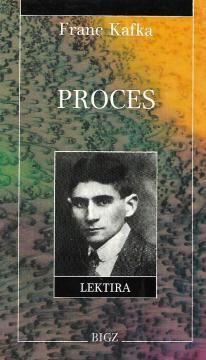
Proces

Proces

Franz Kafka

Kafka wrote The Process between 1914 and 1915, published posthumously in 1925. The novel is unfinished but with an added final chapter by Max Brod. Edition with a foreword by B. Živojinović and an afterword by Walter Killi.

Jozef K., a bank clerk, wakes up on his birthday, arrested by agents Wilhelm and Franz for an unknown crime. He is not taken to prison, but is released with instructions to wait and continue his normal life. He feels surveillance everywhere, kisses his neighbor Fräulein Bürstner, and is summoned for a hearing.

He arrives at a rundown attic-courtroom filled with an audience. The judge accuses him of being late, K. gives a fiery speech against the system, and the scene escalates with public sex between the supervisor and his wife. He realizes that the accusation has not been made public. He returns alone, is seduced by the clerk's wife, but is dragged away by a student. He climbs through a bureaucratic labyrinth, is calmed down by a woman from the office.

In the bank, he sees a whipping man punishing the agents. His uncle takes him to the lawyer Huld, whose mistress Leni seduces him. Huld explains the presumed guilt and the multi-level court. A mysterious clerk appears. The court painter Titorelli offers three outcomes: acquittal (impossible), postponement (eternal), or condemnation.

In the cathedral, the priest tells a parable about a peasant at the door of the law. In the village, he meets a girl and Titorelli. After a year, two men take him to a quarry and kill him with a knife in the heart - "like a dog". The accusation remains a secret, life ends in absurdity.

Original title
Der Prozess
Translation
Vida Županski-Pečnik
Editor
Ljiljana Lapčević
Graphics design
Rade Rančić
Dimensions
18 x 11 cm
Pages
255
Publisher
BIGZ, Beograd, 1990.
 
Latin alphabet. Paperback.
Language: Serbian.

One copy is available

Condition:Used, excellent condition
 

Are you interested in another book? You can search the offer using our search engine or browse books by category.

You may also be interested in these titles

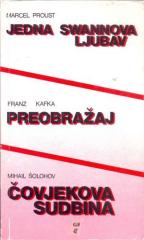
Proces / Preobrazba

Proces / Preobrazba

Franz Kafka

The Process is a novel by Franz Kafka, written between 1914 and 1915 and published in 1925. The transformation is a short story by Franz Kafka, first published in 1915, and certainly his most famous work, along with the novels The Process and The Castle.

Europapress holding, 2008.
Croatian. Latin alphabet. Hardcover.
5.42 - 5.64
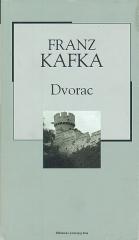
Dvorac

Dvorac

Franz Kafka

The Castle is Franz Kafka's last novel. In it, the protagonist known only as "K." he arrives in the village and struggles to gain access to the mysterious authorities who rule it from a castle supposedly owned by Count Westwest.

Jutarnji list, 2004.
Croatian. Latin alphabet. Hardcover with dust jacket.
4.993.99 - 5.22
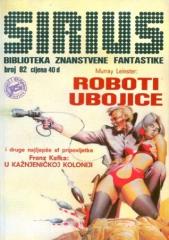
Sirius: Biblioteka znanstvene fantastike - broj 82

Sirius: Biblioteka znanstvene fantastike - broj 82

Murray Leinster, Damir Bajs, Miroslav Bošnjaković, Rastislav Durman, Krunoslav Gernhard, Jakob Z....

Sirius was a Croatian science fiction magazine. The foundation was proposed by Damir Mikuličić in 1976. In Sirius, the works of domestic authors, as well as translations of foreign SF authors, were published. It was published from 1976 to 1989.

Vjesnik, 1983.
Croatian. Latin alphabet. Paperback.
3.46 - 3.48
Kako to reći Liddy: jetka komedija

Kako to reći Liddy: jetka komedija

Anne Fine

Imagine four sisters who share everything from shopping marathons and family dinners to the most intimate secrets. Heather, Bridie, Stella and Liddy Palmer – unbreakable, loyal, impenetrable. Or so they think...

Znanje, 1998.
Croatian. Latin alphabet. Paperback.
3.46
Jamnica

Jamnica

Prežihov Voranc

A novel of one region, written in 1941, just before the collapse of the old Yugoslavia.

Kultura, 1947.
Croatian. Latin alphabet. Hardcover.
4.963.72
Posljednji Stipančići: Povijest jedne patricijske obitelji

Posljednji Stipančići: Povijest jedne patricijske obitelji

Vjenceslav Novak

The novel depicts the social and moral decadence of the Rijeka nobility in the mid-19th century through the fate of the Stipančić family. The head of the family, Niko Stipančić, is an authoritarian father who tries to preserve his reputation and status de

Europapress holding, 2008.
Croatian. Latin alphabet. Hardcover.
4.62 - 6.12