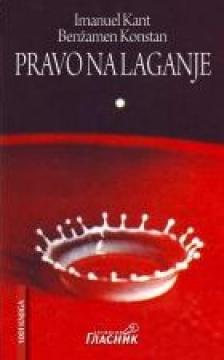

Pravo na laganje

Pravo na laganje

Kant argued that there is no right to lie because telling the truth is an absolute duty, while Constant advocated the possibility of an exception to the duty, arguing that one should lie for the common good, which sparked a famous philosophical debate.

This 1797 discussion begins with Constant's critique of Kant in his essay Des réactions politiques: an absolute duty to tell the truth, if applied unconditionally, would destroy society. Constant gives an example: if a murderer asks about a friend who has hidden in your house, lying would be justified out of philanthropy – because the murderer has no right to the truth.

Kant responds strongly, defending the absolute prohibition of lying. Kant's key arguments:

  • The expression "right to the truth" is meaningless – there is no objective right to the truth, but only a subjective duty of truthfulness (veracitas) towards oneself and others.
  • A lie is a deliberate untruth in a statement to another – it does not depend on harm, but on the violation of a formal duty of reason.
  • The duty to tell the truth is categorical, without exceptions – the basis of all contracts, trusts and rights. If an exception is allowed (e.g. out of love for one's neighbor), the maxim becomes non-universal: the world would collapse into a chaos of distrust.
  • In Constant's example: if you lie to a murderer, you are violating your duty – even if you do not accidentally harm him, lying is a crime against reason. If the murderer forces you to make a statement, the lie is a falsiloquium (untruth), but still a violation – you are responsible for the consequences if the lie enables the crime.

Kant does not allow "white lies" out of humanity – truthfulness is a sacred commandment of reason, of unlimited benefit. Constant sees this as a rigidity that destroys society; Kant sees Constant's approach as opportunism that undermines the foundation of morality.

This debate – one of the most famous in ethics – shows the conflict between absolute deontologism and pragmatic consequentialism.

Original title
Des réactions politiques; Über ein vermeintes Recht aus Menschenliebe zu lügen
Translation
Nebojša Zdravković
Editor
Nebojša Zdravković
Graphics design
Miloš Majstorović
Dimensions
17.5 x 10.5 cm
Pages
97
Publisher
Službeni glasnik, Beograd, 2008.
 
Latin alphabet. Paperback.
Language: Serbian.

One copy is available

Condition:Used, excellent condition
 

Are you interested in another book? You can search the offer using our search engine or browse books by category.

You may also be interested in these titles

Koji su stvarni napreci koje je metafizika ostvarila u Nemačkoj od Lajbnicovih i Volfovih vremena

Koji su stvarni napreci koje je metafizika ostvarila u Nemačkoj od Lajbnicovih i Volfovih vremena

Immanuel Kant
Svetovi, 2004.
Serbian. Cyrillic alphabet. Paperback.
9.99
Religija unutar granica čistog uma

Religija unutar granica čistog uma

Immanuel Kant
BIGZ, 1990.
Serbian. Latin alphabet. Hardcover with dust jacket.
16.24
Kritika rasudne snage

Kritika rasudne snage

Immanuel Kant

Along with the Critique of the Pure Mind and the Critique of the Practical Mind, this third major work of Kant's is one of the cornerstones of his philosophical building, but it also rounds off his entire view of the world.

Kultura, 1957.
Croatian. Latin alphabet. Hardcover with dust jacket.
23.46
Kopernikanska mobilizacija i ptolomejsko razoružanje: Ogled iz estetike

Kopernikanska mobilizacija i ptolomejsko razoružanje: Ogled iz estetike

Peter Sloterdijk

In this provocative essay, Sloterdijk intervenes in the heated debate of the 1980s about modernism and postmodernism. A short, sharp text – essential for understanding Sloterdijk's early approach to aesthetics, media and the crisis of modernity.

Svetovi, 1988.
Serbian. Latin alphabet. Paperback with dust jacket.
8.36
Nietzsche: Biografija njegove misli

Nietzsche: Biografija njegove misli

Rüdiger Safranski

Rüdiger Safranski, known for his works on Schopenhauer, Heidegger, and Goethe, presents an intimate "biography of thought" of Friedrich Nietzsche. The study traces the evolution of his ideas through key events, contradictions, and creative crises.

Sandorf, 2021.
Croatian. Latin alphabet. Hardcover with dust jacket.
25.62
Rad panike

Rad panike

Goran Ferčec, Siniša Ilić

The work of panic by Goran Ferčec and Siniša Ilić is the first volume of the third round of the Friends library, a joint edition of MaMe and Books. Goran's text and Siniša's drawings were created as part of the production of the same name by the BADco gro

Multimedijalni institut, 2020.
Croatian. Latin alphabet. Paperback.
8.427.58 - 9.56