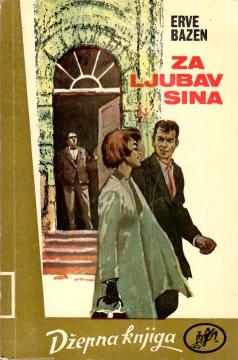
Za ljubav sina

Za ljubav sina

Herve Bazin

An intimate, autobiographical drama about fatherhood, guilt, and complex family relationships. The main character is Daniel, a middle-aged widower who is raising three children alone: ​​twins (an older son and a daughter) and the youngest son Bruno.

Bruno is a rebellious, stubborn, rude and disobedient boy – he often runs away from home, fights, insults and rejects authority. His father loves him deeply, but he does not know how to approach him: his reactions are harsh, threats, blows, attempts at discipline – which only worsens the conflict. Daniel constantly faces his own powerlessness, memories of his late wife and the guilt of not being an ideal father.

The family lives in the small town of Chelles; they are helped by Daniel’s beautiful sister-in-law Laura (who takes care of the house, cooks and looks after the children, but remains in the shadows) and the old Mamette. The novel follows everyday conflicts: Bruno’s escape, police interventions, neighbourhood gossip, Daniel’s internal monologues full of self-blame.

Bazin subtly reveals that Bruno is not Daniel’s biological son (perhaps from his wife’s previous relationship), which adds layers of guilt and insecurity. The father wonders if his love is enough, why he is unable to establish a relationship, and blames himself for Bruno’s rebellion. The story culminates in the moment when Daniel realizes that he must change his approach – not through force, but through understanding and sacrifice.

The style is typical of Bazin: sharp, realistic, tearless, with dark humor and deep psychological insights. The novel explores themes of paternal love bordering on obsession, the effects of war and loss on a family, and how children pay the price of parental weaknesses.

The work is less well-known than “Vipère au poing”, but it portrays family dysfunction and the search for redemption through love for a son just as powerfully. The ending brings reconciliation and hope, but with the bitterness of reality.

Titel des Originals
Au nom du fils
Übersetzung
Milan R. Popović
Editor
Risto Trifković
Maße
17 x 12 cm
Seitenzahl
262
Verlag
Svjetlost, Sarajevo, 1965.
 
Latein Schrift. Taschenbuch.
Sprache: Kroatisch.

Angeboten wird ein Exemplar

Zustand:Gebraucht, in ausgezeichnetem Zustand
Zum Warenkorb hinzugefügt!
 

Interessieren Sie sich für ein anderes Buch? Sie können das Angebot über unsere Suchmaschine suchen und finden oder Bücher nach Kategorien durchsuchen.

Diese Titel könnten Sie auch interessieren

Colomba

Colomba

Prosper Mérimée

Prosper Mérimée's novella, published in 1840, is set in Corsica and explores themes of revenge, honor, and the conflict between the traditional and modern worlds. The novella culminates in a tragic conflict, where love, duty, and violence intertwine.

Zora, 1950.
Kroatisch. Latein Schrift. Taschenbuch.
2,44 - 2,48
Mudroslovna Tereza

Mudroslovna Tereza

Therese the Wise (1748) is an erotic novel by an anonymous author (probably the Marquis d'Argens), mixing the philosophy of the Lumières with explicit scenes. With an introduction by Michel Camus and a foreword by Philippe Roger.

Logos, 1988.
Kroatisch. Latein Schrift. Fester Einband mit Schutzumschlag.
7,365,89
Veliko zaveštanje

Veliko zaveštanje

François Villon
Srpska književna zadruga (SKZ), 1960.
Serbisch. Kyrillisch Schrift. Hardcover.
8,64
Filozofske priče

Filozofske priče

Honore de Balzac

Philosophical Tales is part of Balzac's "Human Comedy", and includes four stories – The Shangri-La, The Elixir of Long Life, The Unknown Masterpiece and Melmoth the Penitent – that explore philosophical, moral and metaphysical themes through complex chara

Kultura, 1949.
Kroatisch. Latein Schrift. Hardcover.
4,22 - 4,25
Ljubičice u srijedu

Ljubičice u srijedu

Andre Maurois

André Maurois, a French writer known for his psychological novels and biographies, explores themes of family relationships, love, and internal conflicts in this work, which is characteristic of his style.

Svjetlost, 1965.
Kroatisch. Latein Schrift. Taschenbuch.
3,42 - 3,62
Katarina Velika

Katarina Velika

Daria Olivier

Catherine the Great (1962) by Darius Olivier is a depiction of the life and reign of Catherine II, Empress of Russia (1729–1796). The work celebrates her strength and vision, but also reveals the personal sacrifices behind her rise, making it a fascinatin

Progres, 1966.
Serbisch. Latein Schrift. Fester Einband mit Schutzumschlag.
1,00 - 4,99