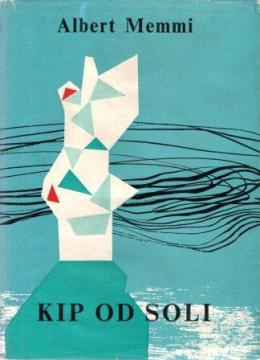
Kip od soli

Kip od soli

Albert Memmi

The Pillar of Salt (1953) is a semi-biographical novel that follows the life of a young Tunisian Jew between the two world wars. Set in colonial Tunisia, the novel explores themes of identity, alienation, and cultural conflict, reflecting Memmi's own expe

Mordecai, the son of a poor tailor, grows up in a Jewish neighborhood, where he faces prejudice from both the Muslim and Christian populations. His quest for education takes him from the local school to a French lycée, where he encounters colonial culture and begins to question his place in the world. He feels torn between his Jewish heritage, his Arab surroundings, and the Western ideals he aspires to. His intellectual ambition and sense of not belonging are further deepened when he goes to study philosophy in Paris.

The novel is deeply introspective, told in the first person, where Mordecai analyzes his inner conflicts and the trauma caused by discrimination and colonial hierarchy. His attempt to integrate into French society encounters obstacles, as he is not fully accepted there either. The title symbolizes Mordecai’s paralysis – like Lot’s wife, he is petrified in his inability to fully accept or abandon any of his identities.

Through a precise and poetic style, Memmi exposes the complexity of the colonial experience and the universal search for belonging. The novel ends without a final resolution, leaving Mordecai in limbo, which emphasizes the tragic nature of his struggle.

Original title
La Statue de sel
Translation
Srećko Džamonja
Graphics design
Zlatko Prica
Dimensions
30 x 14.5 cm
Pages
300
Publisher
Naprijed, Zagreb, 1965.
 
Latin alphabet. Hardcover with dust jacket.
Language: Croatian.

One copy is available

Condition:Used, very good condition
Damages or inconvenience notice:
  • The cover is missing
 

Are you interested in another book? You can search the offer using our search engine or browse books by category.

You may also be interested in these titles

Rudnik čvaraka

Rudnik čvaraka

Tomislav Šovagović

The debut work of Croatian writer Tomislav Šovagović, awarded the Josip and Ivan Kozarac Award in 2012, is a dedication to Slavonia – the region of his childhood that the author, born in Dalmatia, observes with foreign but tender eyes.

Mozaik knjiga, 20112.
Croatian. Latin alphabet. Paperback.
11.56
Deobe

Deobe

Dobrica Ćosić

Deobe is a novel about the tragic division of Serbs into Chetniks and Partisans during World War II. Winner of the NIN Award, it is part of a wider epic trilogy, inspired by Ćosić's experiences and historical documents.

Prosveta, 1963.
Croatian. Latin alphabet. Hardcover with dust jacket.
13.74
Kreutzerova sonata, Hadži-Murat

Kreutzerova sonata, Hadži-Murat

Lav Nikolajevič Tolstoj

Kreutzer's sonata belongs to those works of Tolstoy that the writer adapted in many ways to his view on moral issues, on marital morality above all.

Civitas, 2004.
Croatian. Latin alphabet. Paperback.
4.98
Made in U.S.A.

Made in U.S.A.

Goran Tribuson

Imagine Zagreb in the 1980s, where behind the gray facades of apartment buildings lies a dream world of the far West – Hollywood, freedom and endless possibilities. Tribuson, a master of Croatian prose, here combines genres into one fluid story that bites

Znanje, 1986.
Croatian. Latin alphabet. Hardcover with dust jacket.
5.724.00
Malena je ime tanga

Malena je ime tanga

Almudena Grandes

If you like raw eroticism like Cloud Atlas, this is a sensual saga – emotional, provocative, for those who want to feel the pulse of forbidden passion! Grandes probes whether love is a curse or a liberation?

Mozaik knjiga, 2000.
Croatian. Latin alphabet. Hardcover.
8.54
I ne reče ni reči

I ne reče ni reči

Heinrich Böll

In Boll's novels, one of the central themes is the attempt to preserve basic moral values ​​in a time of terror, as well as in a period of material prosperity and corruption.

Svjetlost, 1965.
Serbian. Latin alphabet. Paperback.
3.22 - 3.98