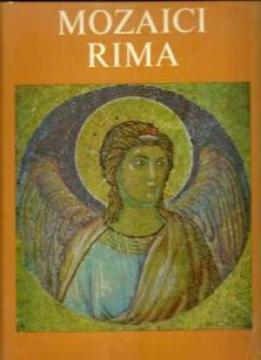
Mozaici Rima – od trećeg do četrnaestog veka

Mozaici Rima – od trećeg do četrnaestog veka

Walter Oakeshott

The mosaics executed in Rome in the period from the 3rd century to the Renaissance belong to the masterpieces of late classicism and medieval art.

Some of those mosaics, such as Giotto's famous Navicella, were created by artists who successfully expressed themselves in other mediums, but most, including the most beautiful ones, were created by artists whose names are unknown.

Determining the authorship and original style is made even more difficult by the fact that the mosaics often had to be restored or replaced due to damage or reconstruction of the building in which they were located. The examination of their authenticity and independence from the influence of the Byzantine tradition is the subject of this book. Since the answers to these questions must largely include their style and technique, the author first describes how they were made and from which materials; what methods were used by the restorers and to what extent they preserved or changed the original idea of ​​the author. Then he describes individual mosaics in detail, showing the development of style and iconography. The analyzes and conclusions drawn by the author are interesting and very significant. He shows not only how the old Roman tradition of realistic portraiture was maintained until the 9th century, but also how Roman mosaics preserved within themselves a Western tradition that was not a provincial offshoot of Byzantine art as previously assumed.

Walter Oakeshott, a distinguished art historian, is known for his works: Classical Inspirations in Medieval Art and The Illuminators of the Vincentian Bible.

Original title
The mosaics of Rome - From the third to the fourteenth centuries
Translation
Vjera Kunc
Editor
Ivan Lalić
Dimensions
31 x 24 cm
Pages
371
Publisher
Jugoslavija, Beograd, 1977.
 
Latin alphabet. Hardcover with dust jacket.
Language: Serbian.

One copy is available

Condition:Used, very good condition
Damages or inconvenience notice:
  • Traces of patina
  • The cover is missing
 

Are you interested in another book? You can search the offer using our search engine or browse books by category.

You may also be interested in these titles

Španjolsko slikarstvo od XV. do XVIII. stoljeća

Španjolsko slikarstvo od XV. do XVIII. stoljeća

Zoran Leskovac, Jorg Wullner, Ružica Marić

On the occasion of the 400th anniversary of the birth of Bartolomeo Esteban Murillo

Gradski muzej Vukovar, 2018.
Croatian. Latin alphabet. Paperback.
4.98
Zorislav Drempetić Hrčić

Zorislav Drempetić Hrčić

Mladenka Šolman

The monograph also provides a biographical framework, an analysis of thematic cycles, an interpretation of the artist's dominant motifs, and numerous reproductions of paintings.

Grafički zavod Hrvatske (GZH), 1989.
Croatian. Latin alphabet. Paperback.
12.46
Bibliografija, izabrani tekstovi

Bibliografija, izabrani tekstovi

Oto Švajcer

The book presents Švajcer's entire bibliography and a selection of his published and unpublished texts (e.g. texts on Krunoslav Kern; Branko Kovačević; Osijek painting between the two wars; Antun Babić as a graphic artist, etc.).

Galerija likovnih umjetnosti, 1995.
Croatian. Latin alphabet. Paperback.
7.32 - 7.36
Ja sam genije

Ja sam genije

Salvador Dali

Dali's autobiographical book in which he explains his life and artistic postulates, the complex foundations of his eccentricity and endless surrealist imagination with which he marked the painting of the 20th century.

Vlastita naklada, 1983.
Serbian. Latin alphabet. Paperback.
8.72
Rafael

Rafael

Armanda Ravazzini

A romanticized biography of the Renaissance painter Raffaello Sanzi, better known as Raphael. The work is enriched with 26 reproductions of Raphael's artworks, which further brings the reader closer to the visual aspect of the artist's oeuvre.

Nakladni zavod Josip Čaklović, 1943.
Croatian. Latin alphabet. Hardcover.
7.62
Grafiti

Grafiti

Graffiti is a contemporary urban art. Painting public spaces with spray paint can enrich the character of a street or city in a specific way. Graffiti is a way of communication and a way of pointing out social problems and an indicator of someone's imagin

Naklada Uliks, 208.
Croatian. Latin alphabet. Paperback.
4.56