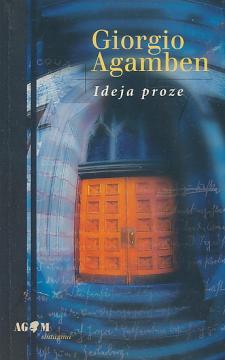
Ideja proze

Ideja proze

Giorgio Agamben

With the works of G. Agamben, tradition is acknowledged to have a role in the transmission of a linguistic or cultural phenomenon from the past to the present, but the transmission is no longer in the service of the return of the same but, paradoxically,

A tradition (tradizione) that requires transmission in the form of translation (traduzione) – because it comes from the past and does not speak the language of the present – ​​cannot but have the effect of betrayal (tmdimento). This revelation of the truth through its betrayal was quite clear to T. S. Eliot's contemporary W. Benjamin: In order for a part of the past to be touched by the present moment, there must be no continuity between them. In other words, if tradition were able to make the whole present, to bring to the surface the entire submerged cultural good, the boundary between the past and the present would disappear without a trace, and with it history. Bearing in mind where exactly such an attempt to deal with the problem of human communication and history would lead, Agamben takes on the task of articulating, in parallel with his most original philosophical project – to think the existence of language as the existence of potency (D. Heller-Roazen) – the continuation of Benjamin by other means.

Original title
Idea della prosa
Translation
Ivan Molek
Editor
Kruno Lokotar
Graphics design
Melina Mikulić
Dimensions
18.5 x 12 cm
Pages
137
Publisher
AGM, Zagreb, 2004.
 
Latin alphabet. Paperback.
Language: Croatian.

One copy is available

Condition:Unused
 

Are you interested in another book? You can search the offer using our search engine or browse books by category.

You may also be interested in these titles

Poetika buke: Antologija slavonskog ratnog pisma

Poetika buke: Antologija slavonskog ratnog pisma

Goran Rem

The Poetics of Noise is a comprehensive anthology edited by Goran Rem, a literary historian and poet from Osijek. The book brings together works by 105 Slavonian authors written during the Homeland War (1991–1995), mainly in Slavonia and Baranja.

Privlačica, 2010.
Croatian. Latin alphabet. Paperback.
29.48
Figure u našem narodnom pjesništvu

Figure u našem narodnom pjesništvu

Luka Zima

Figures in our folk poetry, (JAZU 1880), is published in a reprint after a full 108 years. This classic work of Croatian philology is the first and to this day the only thorough and reliable systematization of tropes and figures in our country.

Globus, 1988.
Croatian. Latin alphabet. Paperback.
9.98
Duh impresionizma i secesije : Hrvatska moderna

Duh impresionizma i secesije : Hrvatska moderna

Viktor Žmegač

Žmegač does not only talk about the visual arts, but about the "spirit" of the era that permeates literature: sensuality, the moment, subjectivity, decorativeness, eroticism, decadence, but also the crisis of identity in the fin-de-siècle atmosphere.

Zavod za znanost o književnosti Filozofskoga fakulteta, 1993.
Croatian. Latin alphabet. Paperback.
8.26
Školski leksikon: Književnost

Školski leksikon: Književnost

Tvrtko Čubelić
Panorama, 1967.
Croatian. Latin alphabet. Hardcover.
3.12 - 3.75
Čitanka iz stranih književnosti 1

Čitanka iz stranih književnosti 1

Nevenka Košutić-Brozović

A reader of foreign literature is intended as a handbook that shows the continuity of general literary development.

Školska knjiga, 1978.
Croatian. Latin alphabet. Paperback.
3.88
Slavonsko ratno pismo: Monografija

Slavonsko ratno pismo: Monografija

Goran Rem

Slavonian War Writing: A Monograph is a scientific study by Goran Rem, a literary historian and poet from Slavonia, on the corpus of war texts written in Slavonia and Baranja during the Homeland War (1991–1994/1995).

Matica hrvatska, 1997.
Croatian. Latin alphabet. Hardcover.
8.366.27 - 9.268.56