Komu je dobro u Rusiji?
Antique

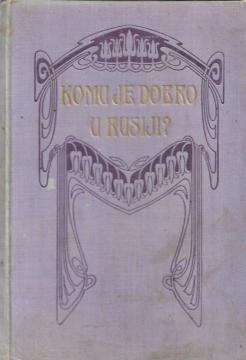
Komu je dobro u Rusiji?
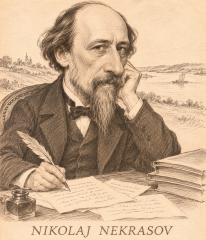
Nikolaj Aleksejevič Nekrasov
Nekrasov

Seven peasants travel across Russia to discover who truly lives well. Their search unfolds into a panorama of poverty, injustice and hope in Nikolay Nekrasov’s unfinished narrative poem.

Nikolay Nekrasov’s Who Can Be Happy and Free in Russia? is an epic poem about the search for happiness within a deeply unequal society. Seven peasants begin arguing over who enjoys a good life in Russia. Unable to agree, they set out to seek an answer among people from different social classes.

Their encounters reveal a country where the abolition of serfdom has left poverty and dependence firmly in place. Priests, landowners and peasants offer competing accounts of their lives, exposing dissatisfaction and insecurity beneath assumptions of privilege. Women’s experiences receive particular attention through accounts of exhausting labour, family pressures and loss.

Nekrasov combines storytelling with songs, folk expressions, satire and moving personal testimony. The journey becomes a broad portrait of Russian rural life, transforming a seemingly simple question about individual happiness into an examination of freedom and social justice.

Although unfinished, the poem develops a powerful tension between suffering and hope. Grisha Dobrosklonov suggests another understanding of fulfilment through commitment to the people and their future. Social criticism and the rhythms of oral tradition give this work its distinctive voice.

Original title
Кому на Руси жить хорошо
Translation
August Harambašić
Dimensions
20 x 14 cm
Pages
160
Publisher
Matica hrvatska, Zagreb, 1905.
 
Latin alphabet. Hardcover.
Language: Croatian.

One copy is available

Condition:Used, excellent condition
Damages or inconvenience notice:
  • Library stamp
 

Are you interested in another book? You can search the offer using our search engine or browse books by category.

You may also be interested in these titles

Doživljaji kapetana Vrungela

Doživljaji kapetana Vrungela

Nekrasov
Nikolaj Aleksejevič Nekrasov
Mlado pokolenje, 1961.
Serbian. Latin alphabet. Hardcover.
3.98 €
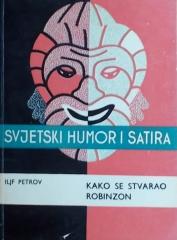
Kako se stvarao Robinzon

Kako se stvarao Robinzon

Iljf, Petrov
Ilja Iljf, Evgenij Petrov

The work depicts the process of creating a literary hero and mocks bureaucracy, superficiality, and the artificial creation of "ideal" stories according to predetermined rules.

Naprijed, 1964.
Croatian. Latin alphabet. Paperback.
3.00 €
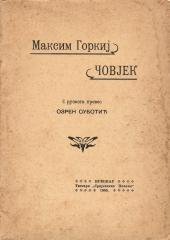
Čovjek

Čovjek

Maksim Gorki

Man by Maxim Gorky, translated by Ozren Subotić (Vukovar, 1905), is a philosophical and literary work that glorifies the dignity of man, his creative power, freedom of spirit, and the fight against social injustice.

Srijemske novine, 1905.
Croatian. Cyrillic alphabet. Paperback.
17.56 €
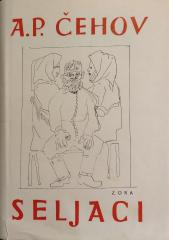
Sabrana djela A. P. Čehova #7: Seljaci i druge novele

Sabrana djela A. P. Čehova #7: Seljaci i druge novele

Čehov
Anton Pavlovič Čehov

Between 1892, when "The Fragment", the first novella in this book, was published, and "The Peasant" (1897) and "On the Carts" (1897), A. P. Chekhov made a series of other artistically successful observations of the society in which he lived.

Zora, 1960.
Croatian. Latin alphabet. Hardcover with dust jacket.
13.62 €
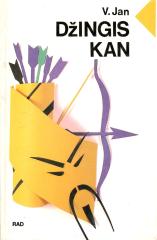
Džingis-kan

Džingis-kan

Vasilij Jan

Vasily Yan's novel Genghis Khan depicts the rise of the Mongol leader Temujin, from childhood in the steppes to the creation of the largest empire in the world, highlighting his courage, cruelty, and relentless will to power.

Rad, 1988.
Serbian. Latin alphabet. Hardcover.
9.76 - 9.78 €
Bijedna ljubav Musorgskog

Bijedna ljubav Musorgskog

Ivan Lukaš

Ivan Lukaš's novel depicts the tragic love story of the great Russian composer Modest Mussorgsky. The novel follows his unrequited love, artistic struggle, alcoholism, and decline in 19th-century imperial Russia.

Savremena biblioteka, 1940.
Croatian. Latin alphabet. Hardcover with dust jacket.
9.24 €